
Archive Record
Images
Metadata
Catalog Number |
1981.4.9 |
Object Name |
Papers, Personal |
Title |
Charles Parker's reflections on the Civil War and General Grant |
Scope & Content |
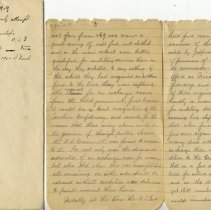
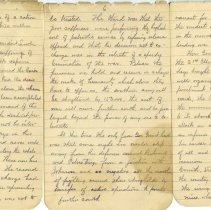
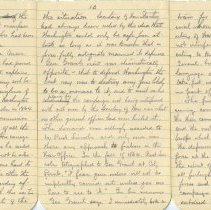
Handwritten manuscript, containing Charles Parker's reflections on the Civil War and General Grant, including thoughts on prisoner exchanges and Grant's presidency, character, and military strategies. He also dispels some myths about Grant and his personality and habits. Envelope has a note from Parker saying "My first, last & only attempts at poetry is in this envelope," with a second note saying "This above endorsement was true from 1866 to 1902, In 1902 I 'burst out' with added slips." Envelope is missing pages 1, 2 and 7. |
Transcription |
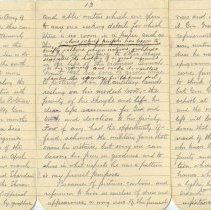
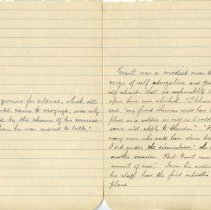
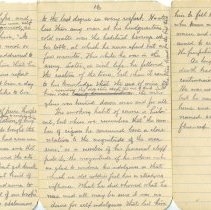
"Not far from 169,000 men – a great army of well-fed, well-clothed, and in the main robust men better qualified for military service than on the day they enlisted, to say nothing of the skill they acquired as soldiers prior to the time they were captured. The request for an exchange came from the Rebel government, first because it would be a tacit recognition of the Southern Confederacy, and second, for the reason that their army alone would be the gainers if, through public clamor, the US Government was forced to accede to it. For not only was the demand advocated of an exchange, man for man, but also that when this was accomplished, all remaining on either side should be released without condition and delivered to points nearest their homes. Probably at this time the US Govt. held five men as prisoners to one survivor of the horrible policy inaugurated by Jefferson Davis in the treatment of prisoners of the armies of which he was the commander-in-chief by virtue of his office as President of the Southern Confederacy, and of this small fraction of those originally captured there was hardly a man who could be made fit for military duty before months of careful nursing had elapsed, and the event proved that when formally released comparatively few ever regained minimal health, while many died within a few months. This exchange then, if granted, meant an addition to the Rebel forces of a great army that in a few days could have been mustered for active service on the one hand, and on the other a smaller number, yet still numbering perhaps 30,000 that would immediately become an added burden on the shoulders of a nation almost financially crushed beneath its three million a day expenditure. The great heart of President Lincoln was moved by the horrible sufferings of the 'boys in blue' whose quick response to his call had thus far preserved the Union established by the fathers, and had the decision rested upon Prest. Lincoln alone, the scheme of the Confederates might have been accomplished. Gen. Grant accepted the command of the combined Union forces with the distinct proviso that his plans should not be interfered with, and as he says in his memoirs, he never did and never would admit that anyone representing the rebels represented a government. Here was his first reason for refusal. The second was that no parole or exchange had been honestly kept by those representing the rebels, and therefore they were not to be trusted. The third was that the poor sufferers were performing the highest sort of patriotic service by refusing release offered, and that his decision not to exchange was in the interests of a speedy termination of the war. Release the prisoners he held and receive in exchange weeks of humanity, which alone they have to offer us, the southern army will be strengthened by 150,000, the cost of war will move further south, and be prolonged beyond the power of anyone to estimate. At this time the only fear Gen. Grant had was that some night Lee would slip away from the defenses around Richmond and Petersburg, form a junction with Johnson and so negating all the months of fighting around stone strongholds by transfer of active operations to points further south. [One page missing here]...warrant for this statement even if it lacked the modest statement of the fact one finds in the memoirs he wrote while death stood bending over him. How General Grant was made Col. of the 21st Illinois Regiment and in a few days brought a mob of unruly men into a well organized and obedient body; his appointment to be a Brig. Gen shortly afterwards; the Battle of Belmont, followed by the movement against Ft. Henry, that led to its abandonment, and the unauthorized attack on and capture of Ft. Donelson by an inferior force, are dramatic events in his career that stamped on the memories of all and need only be alluded to on this occasion. So in fact in regard to Shiloh, Corinth, Vicksburg, Chattanooga, in which the country saw with increasing clearness the rising sun of a great military genius whose victories inspired the hope if not the firm belief that the brain to plan and the power to encompass the destruction of the nation’s foes had been developed in the furnace of war. This indeed proved true. Uncontaminated by influences that proved the undoing of not a few trusted captains, untrammeled by alliances of any sort because of high consecration and singleness (?) of purpose, General Grant came to Washington at the call of President Lincoln in 1864 to receive at his hands his commission as Lieut. General in command of all the land forces of the government. His courage in refusing to accept it unless he could be assured his plans would not be interfered with, illustrated on the one hand its superlative quality, and on the other the knowledge he harnessed regarding affairs at the capitol although this was his first visit and the regiments of the … the situation. Secretary of War Stanton had always been ruled by the idea that Washington could only be safe from attack so long as it was known that a force fully adequate manned its defenses. Gen. Grant’s view was dramatically opposite, – that to defend Washington the best way was to destroy any force likely to be a menace to it; and to insist on plans for the campaign not being interfered with not even by the Secretary of War was what no other general officer had even hinted at. The demand was willingly acceded to by Prest. Lincoln and only once was there any approach to friction in the War Office. In the fall of 1864, Prest. Lincoln telegraphed to Gen. Grant at City Point, 'I fear your orders will not be implicitly carried out unless you are here to see it.' In his memoirs Gen. Grant says 'I immediately took a train for Washington and on my arrival where [I] had an interview with [the] Secretary of War. After that my orders were not interfered with.' It would be interesting to know just what that usually silent General, but who on occasion could use language about which there was no mistake. First with that "interview," though it makes no part of history. The first thing Gen. Grant did on assuming command was to continue in office the then commander of the Army of the Potomac and the rest to order the splendid body of troops which for two years had manned the defenses of Washington, to join the active force at the front, increasing the army to the extent of some 20,000 troops, to annul all furloughs, concentrate and reorganize the forces and perfect details for the plan of campaign to be opened in early spring. It enhanced the entire field of operations north south and west, with the Army of the Potomac reckoned as a centre, thus concentrating all the forces to more simultaneously against the Confederate forces on the several sections of the country. – Lee in defense of Richmond, Johnson in the south, Forrest in the west. Better to move forward towards Richmond along the banks of the James in conjunction with the advance of the Army of the Potomac of which Meade was the ranking Maj. Gen. The history of the eleven months covered by Grant’s advance on Lee’s army in the 'Wilderness' of Virginia in May 1864 to the surrender of the rebel General at Appomattox in April 1865; coupled with Sherman’s march from Atlanta to the sea and Sheridan sweeping Early’s force from the Shenandoah valley, fills volumes of official records and other volumes by graphic (?) and able writers which are open to any one seeking details for which there is no room in a paper such as this, whose chief purpose has been to briefly outline why a nation's gratitude suggested the character of a great monument to his memory and make its vaulted chambers the repository for his honored ghost.... The purity of his thought and life, his clean life, reverence for God and truth and devotion to his family. Few if any had the opportunity offered, achieved the military fame that crowns his virtues, but everyone can become his peer in goodness, and to show in what respects he was a pattern is my present purpose. Because of pictures, cartoons, and references to him as careless of dress and appearance, a wrong view of the personal was and is prevalent, while the fact is, Gen. Grant was the embodiment of refinement, and in regard to his person, neatness personified; but of outward dress he was always careless. His brief, epigrammatic sentences that have become familiar words have led many to think of him as 'rude of speech,' but Gen. Grant was educated in the school at West Point, was a great leader, and the mass of official papers, his life (?) will be scanned in vain for evidence that he had not a perfect command of the English language, while all who knew him intimately refer to the purity and correctness of his conversation, which was often brilliant with humor when the situation suggested a higher (?) to the matter being considered. But these traits are of less importance than his truthfulness, clean life and perfect control he had acquired over his inner self so that an intimate says of him, "no one ever heard an irritable word or a disagreeable expression addressed to any one." What wonder, then, that he could remark, as several companions report him as saying, 'There has not been a day in my life that I would not like to live over again.' Strange to say this man of pure thought and clean life at one time had the reputation due to newspaper stories of being a drunkard, and jealous rivals brought the story to Prest. Lincoln. Lincoln had never seen Gen. Grant, but with that keen common sense that was a strong characteristic, he sensed the situation, and his reply is historic. – 'Grant gets drunk, you say. Hell, you find out what kind of liquor he uses and I will send some to the other generals in command of our troops.' The fact is Grant was (?) to the last degree in every respect. He ate less than any man at his headquarters, cold water was the habitual beverage at his table, at which he never spent but a few minutes. This while he was in the army. Later, in civil life, he followed the custom of the times, but when it came to his knowledge that the use of wine …was reviving the old story about him being a drunk, the wine glass was burned down once and for all. His smoking habit of course is historical, but when we remember that 'the number of cigars he consumed bore a close relation to the magnitude of the occasion,' as a member of his personal staff puts it, the magnitude of his victories makes us glad to condone his indulgences in that which we old soldiers feel has a steadying influence. What he did showed what he was, and all may be sure it was no desire for indulgence that led him to fill his pockets with cigars when he who knew no such word in fact set out to oversee and direct the plans by which he aimed to circumvent the enemy and achieve the perpetuity of the Union. As long as Grant lived and after death had claimed him, there were controversies regarding his religious beliefs. He was not a member of any church, but he was brought up in a Christian home and the characteristics already named show how his life had been influenced." [Other thoughts by Parker on Grant, in between pages 14 and 15 of the envelope]: "His genius for silence, which all the world came to recognize, was only equalled by the charm of his conversation when he was moved to talk." "Grant was a modest man to the verge of self abnegation, and yet a self-restraint that no responsibility thrust upon him was shirked. ‘I believe,’ he said, ‘my friend Sherman could have taken my place as a soldier as well as I could and the same will apply to Sheridan.’ ‘There are many men who would have done better than I did under the circumstances,’ he said on another occasion. But Grant never held a ‘council of war.’ From his written orders, his staff had the first intimation of his plans." |
Date |
1866 - 1902 |
Year Range from |
1866 |
Year Range to |
1902 |
People |
Parker, Charles Symmes Grant, Ulysses Lincoln, Abraham Davis, Jefferson Meade, General |
Subjects |
Military officers Politicians Prisoner exchanges Prisoners of war War War effort Military service Military leadership Military life |
Search Terms |
Civil War Civil War Veterans |
Source |
Wood, Mrs. Barbara |