
Person Record
Metadata
Name |
Whittemore, Samuel (1696-1793) |
Other names |
Capt. |
Born |
27 Jul 1696 ? |
Birthplace |
Charlestown |
Deceased |
3 Feb 1793 |
Deceased where |
Menotomy |
Father |
Samuel I Whittemore |
Mother |
Hannah Churchwell Rice |
Places of residence |
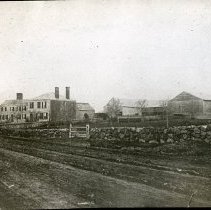
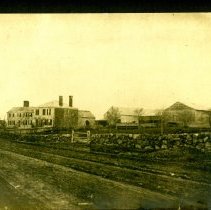
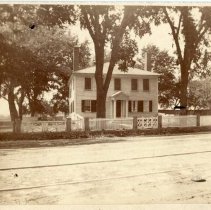
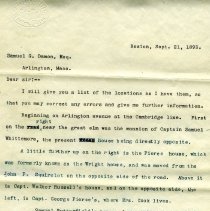
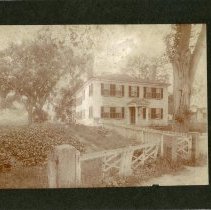
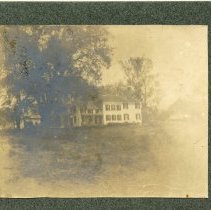
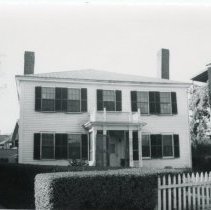
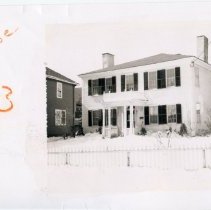
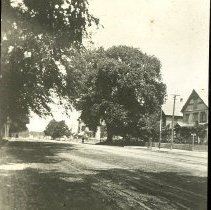
1775 Lived with son and his grandchildren "in the house under the shade of the old elms, just this side of the borook which divides us now from Cambridge - W. C. 1775 (two Whittemore houses across from each other, often mistaken for one another. Sons either Samuel, Thomas, or William |
Notes |
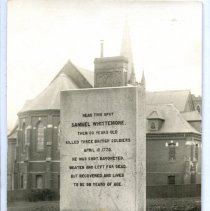
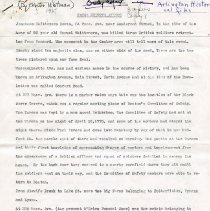
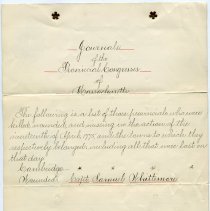
After seeing Lord Percy's regiment pass, he gathered up his "Kings Arms" musket and powder horn used in French & Indian War ("Old French War") Fought and bayoneted and left for dead. Said to have killed 2 British soldiers, shot and bayoneted 6 or 8 times by them, 80 years old, survived another 18 years. Whittemore, Samuel (27 July 1696-3 Feb. 1793), farmer and folk hero of the American Revolution, was born in Charlestown (now Somerville), Massachusetts, the son of Samuel Whittemore and Hannah (maiden name unknown), farmers. As a young man he served with a royal regiment, the King's Dragoons, and attained the rank of captain. Whittemore's military reputation led to his election to numerous town offices in Cambridge, where he owned a farm at Menotomy (now Arlington) on the Alewife Brook. He rose to be deputy sheriff of Middlesex County, in which capacity he struck his first blow for liberty. In 1740 Whittemore ran afoul of the wealthy West India planter and merchant John Vassall, who lived in Cambridge and had been elected its representative to the Massachusetts House of Representatives the previous year. When Vassall lost the 1740 contest, Whittemore commented that his interest "attained its full growth suddenly, like Jonah's gourd, and as suddenly collapsed," adding that Vassall "was no more fit to discharge the said trust than the horse that he . . . rode on." Vassall, who spent a good deal of his life suing people on one pretext or another, sued Whittemore for £1,000 in damages, which the Middlesex County Court of Common Pleas refused to grant. Whittemore then countersued for £200 and won. According to local tradition, he served his warrant on Vassall "at his own table, while surrounded by a large and fashionable dinner party." Whittemore's dislike of Vassall typifies the resentment resident farmers of small towns surrounding Boston felt when wealthy merchants, seeking relief from the city's crime, disease, and taxes, moved to nearby communities in the 1730s and 1740s and expected deference on account of their wealth. Whittemore lost none of his ire against intruders into his community as he grew old. When the British marched on Lexington and Concord in April 1775, he exhorted the local militia to stand bravely in defense of their liberties. "If I can only be the instrument of killing one of my country's foes, I shall die in peace," the 78-year-old farmer exclaimed. As the British retreated from their debacle at Concord toward Boston, Whittemore positioned himself behind a stone wall on his farm with a musket and pair of pistols, killing three redcoats. The enraged soldiers then charged him, shouting "kill the old rebel," stabbed him with their bayonets, shot him in the cheek with a musket, and left him for dead. However, he survived another eighteen years and, as his obituary noted, lived "to see the complete overthrow of his enemies and his country enjoy all the blessings of peace and independence." Whittemore was married twice, first to a woman named Elizabeth (full name unknown), with whom he had ten children. His daughter Elizabeth married William Cutler and was reputed to have had thirty-six children with him before she died at the age of thirty-five in 1770, which is almost certainly an exaggeration. Whittemore's first wife died in 1764. Shortly thereafter he married Esther, the widow of both Thomas Prentice and Amos Muzzey. Whittemore died at his farm in Cambridge. A stone marker honors "Uncle Sam" Whittemore at the site of his farm near the intersection of Alewife Brook Parkway and Massachusetts Avenue in Arlington. His tale illustrates the long lives, numerous progeny, and fierce devotion to liberty of the Minutemen of eastern Massachusetts, to whom in large part we owe both the independence of the United States and much of its population. Lucius C. Paige, History of Cambridge (1877), which includes the Whittemore genealogy, is the principal source of information on this obscure farmer. He is mentioned in Arthur B. Tourtellot, Lexington and Concord: The Beginning of the War for America (1959), and two works by David Hackett Fischer, Growing Old in America (1978) and Paul Revere's Ride (1994). An obituary is in the Columbian Centinel, 6 Feb. 1793. |
Occupation |
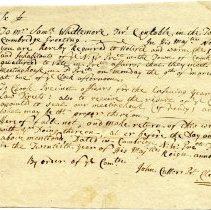
Pct. committeeman 5 years between 1734 and 1747; pct treasurer 1751-57, and pct assessor four years; selectman and assessor sixteen years, 1743-46, 48-57, 59, 62; served on important committees during the Revolutionary period, and had been Captain of Dragoons. |
Spouse |
Elizabeth Spring she d. 5 June 1764 age 63 or 64, 2nd Esther Prentice |
Children |
Samuel, Thomas, William (all listed in DB) Elizabeth m. William Cutler 1743 Sarah m. John Dickson Jr. 1749 Susanna d. "of sudden illness" on 5 Apr 1752 a 20 yrs Hannah m. Thomas Cutter 1757 Mary b. 5 May 1741 m. Stephen Whittemore 3rd of Medford 1763 |
Related Records
-
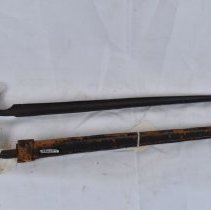
1907.11.2 - Bayonet, Socket
Bayonet with the leather sheath appears to be the older of the two bayonets, attributed to Sam Whittemore, possibly used in battle on April 18, 1775. The bayonet features a steel socket to fit over a musket barrel, with the L-shaped cuts to engage the bayonet lug and lock into place. The neck of the bayonet extends from the front of socket then curves upwards into the blade. At the base of the neck a slight fissure is visible, where the blade was...
Record Type: Object
-
-
-
-
-
-
-
-
-
-
-
-
-
-
-
-
-
-
-